Wednesday, August 24, 2011

Lost in Transliteration


Transmogrifier is a device into which a person goes thinking of becoming of something and comes out thinking being exactly that. (Invented by Lord Calvin and Sir Hobbes).

Transliterator is a device, where a sound goes into it in one script and comes out the same in another script.

I never understood the spelling-bee contests. Young kids producing words out of infinitely bewildering phonetics. "trouvaille" (meaning: finding) goes one word, pronounced "truva" as many as 4 letters are silent. These spelling bees are only gonna get tougher, and in three years from now we may have the announcer keeping mum and the poor student will have to find the word, because, er.. all the letters are silent. Kudos to the effort and memory power of the students though.

The whole spelling bee concept is based on the platform of arbitrary and artificial phonetics. If there were a one-to-one correspondence between sound and script, the spelling-bee will become a drone-bee. If we rule that English be written phonetically from tomorrow, spelling assignments would disappear. What you say is what you hear is what your mind interprets. WYSIWYHIWYMI.

This reminds of artificially created problems and equally artifical solutions. A good analogy is some of the Java design patterns like Iterator (where you write elaborate classes) "disappear" in dynamic languages like Groovy. The Java design patterns have been elevated into language features of Groovy, so there is no "problem" to start with!


So how many times in life will you ever use that word again? That thought makes me nostalgic about those toefl and gre vocabularies where I crammed words to better the neighborhood guy whose veneer impressed my folks, while I stood exasperated. How many of those words am I using now? How many of those words are being used by native English speakers? And I'm told that I should use simple language while writing emails to clients. If I use the words appoggiatura or roscian, the client will simply take the business elsewhere, because I am hard to communicate with. The fact is, for effective communication you just need around 1000 words in any language. The rest are for poets and dictionary makers who just want to intimidate us ordinary folks and to float themselves in business :-)

Sanskritam students often wonder what is the best way to type in Sanskritam. There are a few great tools -
Baraha, Google Transliterator etc. There are also a few english transliteration schemes available for the devanagari script. Which one to choose? I feel each of them try and have their own quirks. Lets examine some of those:

The Harvard-Kyoto is mostly used in academic circles. The most jarring usage in this scheme is that of uppercases for anunasikas (G/
ङ्, J/ञ्) and z for fricative श. Try however, I could not pronounce z as श while reading. Just like the Tamil zh/ழ doesn't make any sense, but we just adapted it.

IAST is more confusing with multiple latin alphabets for the same devanagari akshara (k, K -> क, kh, Kh -> ख). Do you ever substitute one letter for another in English? Then why such karakter overdoz for transliterashuns?

ITRANS is even crazier. Doubled or uppercases (aa vs A), exponent symbol (R^i), doubled uppercases followed by lowercases (LLi), tilde before, power after, dot before, dot after - its hard to write in ITRANS unless you are already a mathematical genius. It could have also used integral and sum symbols - one could learn advanced calculus simultaneously while writing saMskR^itam.

The other side of the text is parsing into comprehensible data structures. Writing parse routines for such schemes involve quite a bit of effort. So the question is, can there be a simpler, consistent scheme, with fewer things to remember while typing?

Here is one such minimalistic transliteration scheme and it uses only 4 main rules and 3 corollaries:

Rules

1. lowercase 2. uppercase 3. possible dot after a letter 4. semi-colon for visarga; jihvamuliya; upadhmaaniya

Corollaries

1. uppercase for dIrgha
2. krama -> lowercase; lowercase+dot; uppercase; uppercase+dot
3. 1:1 mapping in the transliteration

a A e E u U r. R. l. E. I O O.

k k. g g. n
c c.j j. n.
t t. d d. N
T T. D D. N.
p p. b b. m
y r l v s s. S h
M :
a. (avasarga)

The principles behind the scheme are:
  1. A devanagari letter is either ONE char or ONE char + dot.
  2. The scheme is almost consistent (lowercase, lowercase+dot, uppercase, uppercase+dot, uppercase for dIrgha svara). This is why we get an orderly (n, n., N, N.)
Parsing or tokenizing such a scheme is also easy. There is only one if condition to determine an akshara - if a dot follows letter, they form one akshara, if not, that letter is the akshara.

In other words, converting a sentence into unicode is just one-line, assuming the unicodeMap[:] is defined already.

def toUnicode(s,i => return this.append(unicodeMap[s.charAt(i+1) == '.' ? s.substring(i,i+2) s.substring(i,i+1)]);

Q & A


Q. Why favor the 1:1 mapping? After all isn't it good to have options and easy to write in different ways?
A. It sure is, but do you really substitute one letter for another letter in English or Sanskritam? Can you say "sha" is close enough to "sa" and use it for "savam"? A 1:1 mapping allows no options and eventually it gets streamlined in a person's thought process.

Q. viDE.he -> isnt this hard to read than vaidehi ?
A. Yes it is, no doubt. But how did you learn to pronounce it as "vaidehi" with "d" as
द while the most common pronunciation of d is ड ? It will be hard read at first, but didnt we all start with guessing what a dot, dash, tilde, apos mean on top and bottom of the letters :-). If one is already used to a scheme the mind resists a change.

Q. So whats really easy about this scheme?
A. If you are well versed with the devanagari krama, it is probably easier to apply the transliteration. Also there is only the extra character dot to remember.

Q. Whats really difficult, then?
A. Reading will be unnatural for those who are used to different scheme (eg nAraayaNa vs N.ArAyaNa). We are so much used to N being murdha nakara! But even the existing schemes were originally unnatural, so the unnaturalness just shifts to a different section.


(Note: This article is not to challenge existing schemes, but to show a minimalistic scheme ie a scheme with minimum fuss is possible from a parsing perspective. In any art form, the prevelance rules over theories). 

Friday, August 19, 2011

Bodhi learns Sanskrit

बोधि: संस्कृतं पठति

Amar Chitra Katha. The printed granny of Indian kids. That and its cousin Tinkle have been a source stories for a few decades now with a lot of nostalgia for my generation. From puranic to folktales to heroes, it has remained a valuable source of stories in compact format. I wish ACK brings out a full edition of Kathaa-sarit-saagara and similar Sanskrit works, which contains some great stories. Obviously there are already some stories published from it, but not a complete edition.

Though ACK/Tinkle has a lot of stories based on Sanskrita literature, rarely there are stories with Sanskritam itself as the theme.

The below is a translation of a funny story "Bodhi learns Sanskrit".


कस्यांश्चित् पाठशालायाम् बोधि: संस्कृतं पठति । अध्यापक: सर्वान् छात्रान् पाठयति ॥

अध्यापक: वदन्तु । ... राम: ... रामौ ... रामाः ॥
(छात्राः पुनरुच्छारयन्ति)
अध्यापक: ... रामं ... रामौ ... रामान् ॥
(छात्राः पुनरुच्छारयन्ति)

....

अध्यापक: अथ अङ्ग-पाठः । ... मम शिरः । (स्वशिरः स्पृशन्) ... मम शिरः ॥
छात्राः ... मम शिरः । ... मम शिरः ॥

तदनन्तरम् सर्वे स्वगृहम् गच्छन्ति । बोधि: अपि गृहम् गत्वा अभ्यासम् करोति ॥

बोधि: मम शिरः ... । मम शिरः ... । मम शिरः ... । इत्युक्ते अध्यापकस्य शिरः ॥

(बोधेः पिता तत् श्रुण्वन् तत्र आगच्छति । कोपेन तर्जयति)

पिता: अरे मूढ ! एतादृश: वा भवतः संस्कृत पठन लक्षनम् ? ’मम शिरः’ इत्युक्ते अध्यापकस्य शिरः न । (स्वशिरः स्पृशन्) मम शिरः । (पुन: स्पृशन् उच्चैः) मम शिरः ॥

(पिता उक्त्वा निर्गच्छति)

बोधि: (किञ्चित् कालं चिन्तयित्वा) । ... आ ... आ ... आम् । इदानीम् अवगतम् । पाठशालयाम् ’मम शिरः’ इत्युक्ते अध्यापक: शिरः । गृहे ’मम शिरः’ इत्युक्ते पितु: शिरः । अवगतम् । अवगतम् ॥

Tuesday, August 9, 2011

Six degrees of Sutras

One of the memorable humour tracks of Tamil movies is from arivAli (The Intelligent) made in early 1960s. A black white film, with simple clean humour. Very likely such movies were made in other Indian languages too. The husband asks his wife to make puri. Wife does not know how to make it, so husband gives instructions to her:

Husband: Take a vessel and put some wheat flour in it
Wife: Yeah, I know that!
Husband: Pour some water and salt and mix with flour
Wife: Yeah, I know that!
Husband: Make it into small round balls
Wife: Yeah, I know that!
Husband: Flatten it and make it round like appalam
Wife: Yeah, I know that!
Husband: Then what?
Wife: Aah, I dont know that...


In an earlier post we saw how a sutram's definition can be applied to naming convention of variables in modern programming context. A natural question arises - what are the types of sutram-s? As I have mentioned before, classification is ancient Indians' forte. There are six types of sutram-s which is defined, yeah you guessed it, in a shloka:

संज्ञा च परिभाषा च विधि: नियम एव च ।
अतिदेशो अधिकारश्च षड्विधम् सूत्र-लक्षणम् ॥


A lot has been described about this classification in wiki articles and elsewhere. Here we will just look at the parallels between this classification and programming concepts.
संज्ञा - definition; परिभाषा - interpretation; विधि- rules; नियम - restriction; अतिदेश- extension; अधिकार - header/domain.

संज्ञा is a definition sutram. It gives a meaningful name for one or more symbols. Do you remember your early programming days where you are told that a good practice is to give a name for constants? (Do you still follow that?)
 

वृद्धिरादैच् |  [1.1.1]  {a, e, o} are called vRuddhi |
 

In programming terms, this is like the classic C #define statement or final static/const statements in Java/C# world. 

#define PI 3.14

#define IK_PRATYAHARA {i, u, Ru, Lu}


परिभाषा sutram is an interpretation or meta-rules sutram. Its function is to tell how to interpret other sutram-s.
      
तस्मात् इति उत्तरस्य | [1.1.67] When a sutra has a word in panchamI vibhakti, then the word next to it will undergo some modification. 


A very good equivalent to interpretation rules is Annotations. This example will make it clear:


@WebMethod(POST)
public void updateUser() {
}


The annotation says that the method updateUser() must respond to only a http post call. It helps the runtime interpret the method in a certain way.

विधि sutram: What is the fundamental difference between a calculator and a computer? The calculator (a regular) deals with numbers only, while the computer can make logical decisions.

विधि sutram is the classic if-else-condition. In fact, the way पाणिनि has applied it - its closer to aspect-based rules than just a vanilla if-else condition. There is a slight difference between "if do this" and "when apply this". While the if-condition has to be encountered during the execution process thread, a when-rule applies anytime during the happening of a certain condition. "if" is thread-execution based, while "when" is time based, a trigger with an "if".पाणिनि defines several rules in his अष्टाध्यायी. For example there is a famous sandhi rule with just three words, that covers a matrix of sandhi-s.
       
इको यण् अचि | [6.1.78]
When a vowel follows, the letters i, u, Ru, Lu change to y v r l.

Obviously any if-else condition would be a vidhi sutram. If we were to follow paaNini's technique, we would not write it as a simple if condition. Instead we would define all "when rules" in a separate section of the code, and provide aspects of applying. When code executes, the aspects will monitor the code and "apply" a rule when those conditions are satisfied. For eg the (now) Oracle's Haley is one of the very popular Rules Engine products, in which Rules can be defined in simple English.

नियम sutram
If programming was based on socialistic ideologies, rules would apply uniformly to all cases (except the political class, of course). But reality is somewhat capitalistic, so there is always some case which disagrees to agree. Remember the business requirements like "should apply to all but one or two cases" and the complex if-conditions you would have to write to handle just the boundaries?

Restriction is not Exception. Exception is an alternative flow, but restriction is about applying a rule to a lesser number of or rarer cases. In general, it is achieved by if-else conditions, but doesn't always have to be so.

अतिदेश sutram-s are extensions. They qualify a pre-existing rule with another property, not originally possessed.
   
Using pratyaya-s vat and mat, paaNini extends the behaviour of one rule and applies to another rule.
       
लोट: लङ्वत् | [] would mean "लोट् vibhakti-s are to be conjugated just like लङ्"
       
Imagine that
लोट्, लङ् etc implement an interface called "ल". Panini's technique essentially casts लोट् as लङ्.
       
Class extensions are very common in OO languages. Using the Extension mechanism offered by Ruby, C# etc, one can improve the functionality of an existing class. For eg, String class does not have intrinsic methods to check if the value is null or empty . One could add a IsNullOrEmpty(this String) method and operate directly on a string instead of a new helper class.
       
It does not end there. Imagine two objects User and LockedUser:
       
User user; //normal user behaviour
LockedUser lockedUser; //a locked user behaviour, imagine a Trait (see Scala which allows partially implemented interfaces)
if (user.failedAttempts(3)) { user.setBehaviour(lockedUser)); } //user now behaves like a lockedUser

       
Instead of changing the state of the object (commonly via isLocked() or status = LOCKED), the behaviour of the object itself is changed. Upon certain conditions, the regular user adapts the behaviour of a locked user. We do not directly deal with properties and state changes, instead work with behaviour changes. For eg, Scala offers Traits, with partially implementable methods, which are much more than interfaces. In a way you are describing or coding to the behaviour of an object rather than the states.
       
अधिकार sutram: If you have done database modeling, you know Subject Areas. In programming terms, think of package, namespace etc. They all define a domain underwhich certain rules/classes/tables are grouped. Thats exactly what adhikara sutram is. More information on adhikara sutram can be found in this post.
   
संहितायाम् | []  "During the closeness of words"
प्रत्यय: | [3.1.1] "Affix"
       
package com.microsoft.office;
namespace Com.Sun.Oracle.Java;
//ok, I was being facetious :-)


Apart from these core sutram-s there are a few more.

निषेध sutram-s are negation rules of other rules. While niyama sutram-s are positive restrictions, nishedha can be seen as negative orientation.
   
हलन्त्यम् | (consonant endings are it-markers)
न विभक्तौ तुस्माः | (but
letters t, th, d, dh, s, m are not it-markers if it is used for conjugations)
       
In programming, we can come up with a validation rules engine like this:
       
1. All Address Fields Required
2. Not if Address Line 2
       
Imagine the simplicity of a program using such a validation engine!
       
विभाषा sutram is an optional rule. For eg think of the sentence "I would like to goto a movie". You can also say it as "I'd like to goto a movie". The shortening of "I would" to I'd does not change the meaning, and is optional to use. पाणिनि uses this technique to provide alternative usages of words and grammar by using the shabda-s vaa, vibhaaShaa, anyatarasyaam. Optional rules are very common and are done using if conditions.

Besides these, some of the paaNini's techniques also strike a chord with modern techniques. For eg, there is an interpretation sutra विप्रतिषेधे परम् कार्यम्, which means "In case of rule-conflicts, the latter rule prevails". Virtual override feature?

Another unique technique is called स्थानी भाव where a substituting suffix can retain the characteristics of a substituted suffix. Heard of Liskov Substitution Principle? Yeah, something like that.

Panini also uses recursive techniques for some of the rule operations. We will see that in a subsequent post.


Yet another ingenious technique is seen in the last 3 pada-s of अष्टाध्यायी where every previous rule is oblivious to all the latter rule. The rules are arranged in such a way that every rule "thinks" that it is the last rule of the book.


So what is the benefit of comparing modern programming with a 2500+ old text book of grammar? Let it be पाणिनि:, Capellini or Linguini founded algorithms. As a software engineer, what do I care? I do not have an answer. After all, a programmer consultant in US writes a for-loop for $75 an hour, while the same for loop is written by some one in China for a few Yen. Can you judge which for-loop is better?

If several of modern programming concepts have indeed parallels in अष्टाध्यायी, how about some concepts in अष्टाध्यायी not yet formulated into modern programming theories? What if they could create a fundamental change in theory of programming?

What would पाणिनि: think about modern programming concepts? To find out, we shall send Donald Knuth back in time as our representative.

Knuth: Programming is about definitions, rules and algorithms.
पाणिनि: आम्, जानाम्येव !
Knuth: Using algorithms we derive and solve various equations.
पाणिनि: आम्, जानाम्येव !
Knuth: In object oriented programming, we do abstraction, polymorphism and other cool things.
पाणिनि: आम्, जानाम्येव !

Knuth: With functional programming, we define functions, recursions and closures.
पाणिनि: आम्, जानाम्येव !
Knuth: Then we create programs to play games like Grand Theft Auto all day long.
पाणिनि: अहो ! तदहम् न जानामि !!

Friday, July 29, 2011

Better than the best

श्रेष्ठेभ्यो श्रेय: |

In the superhit 1965 Tamil movie Thiruvilayaadal (Divine Sport), there is a classic scene where the poor poet Dharumi brings a poem for a prize announced by the Pandya king. Nakkeeran, the court poet, happens to doubt the authenticity of the composition. (It was indeed given to him by Shiva and was not Dharumi's original). Dharumi reacts sarcastically -

"பாட்டெழுதி பேர் வாங்கும் புலவர்கள் இருக்கிறார்கள். குற்றம் கண்டு பிடித்து பேர் வாங்கும் புலவர்களும் இருக்கிறார்கள்"
"There are poets who become famous by their own effort. And there are poets who just criticize others and become famous".

But then the world owes much to artists whose claim to fame is only critiquing/commenting somebody's work. Take Mallinaatha for example, without his significant and monumental commentary it would be impossible to understand meghadhUtam or shishupaalavadha. So much so that Mallinaatha says "माघे मेघे वयम् गत:" (Life's gone in reading maaghakaavya and meghadhUtam). There are geniuses who create phenomental stuff and then we need mediators to such geniuses to expound it for us ordinary mortals. Or take Panini vs Patanjali. Panini's pataakhi-sounding pratyaahaara-s like ढक्, डुप्, दप्, घञ्, क्ङित्, तिप्, थस् sounds could only be expounded by a genius like Patanjali. We need a Hardy and several more, just to decipher us the genius of Ramanujan. Some cant stand that - like George Polya, the Hungarian mathematician who refused to get caught in Ramanujan's theorems, for the fear that he would spend his life just proving them, and never discover anything of his own.

शिशुपालवध is no doubt one of the greatest mahakaavya-s. Among the pancha mahaakaavya-s it is considered the greatest. A famous subhaashitam says that माघ has the exceptional qualities of all three poets कालिदास, भारवि and दण्डिन्.

Think about shishupaala for a moment. Forget that he is a villain, thats a simplistic view. He consistently challenged Krishna's superiority, for whatever reasons. He showed scant respect for Krishna, repeatedly insulted him and asked others during the raajasUya-yajna "Isn't there one person who is worthy of honor than this shepherd?". People like shishupaala are not incidental, and are not coy to challenge superiority, no matter who it is. Similarly, Nakkeeran challenged the poem of Dharumi. From Dharumi's point of view, Nakkeeran criticized him. But Nakkeeran challenged the poem, the one written by Lord Shiva himself. The greatness of art is strengthened only if it can withstand any challenges. So it is only natural someone challenged the superiority of Maaghakaavya. And such a challenger was Vadiraja Tirtha.

Like several Sanskritam literature works, this one too is hardly heard of, except in a few elite circles. I had earlier mentioned that it is only our loss not savoring the Sanskritam language of scriptural literature. There appears to be a lot of noise around "secular" Sanskritam literature, whatever that means, side-lining the beauty of the language shining in other fields.

Vadiraja Tirtha is no ordinary poet. He has produced a prodigious amount of work in several fields - kavya, stotra, stuti, travelogue, commentaries, logic, cosmology and a lot more. Some of his works run into thousands of verses. And yes, living for a full 120 years (1480 to 1600 CE) helped him too! And he ensured a productive life. This event is recorded in the biography book shri vaadiraaja guruvara-caritaamRuta:

तत: पुण्यपुरीम् प्राप्तो भेरीताडनपूर्वकम् । काव्यश्रेष्ठं माघकाव्यं गजमूर्ध्नि पूज्यते ॥
इत्याघोषितमाकर्ण्य सभापतिमवोचत । अस्मत्पुरे महाकाव्यमेकम् श्रेष्ठं प्रकाशते ॥
दीयते समय: कश्चित् दर्षयिष्ये परीक्ष्यताम् । अङ्गीकुर्वति विज्ञौघे गुरु: एकोनविंशता ॥
दिवसै: एकदिवसे हि एकसर्ग क्रमेण स: । रुक्मिणीश महाकाव्यं निर्ममे सुरसाकरम् ॥
अवेक्षणाय विदुषां संसदं प्रैषयेत् सुधी: । परिषत्सा परीक्षाय विस्मित आनन्दपूरिता ॥
रुक्मिणीश महाकाव्यमुत्तमं माघतोऽपि च । इत्याघोष्य च सम्मान्य प्रार्चयत् कविसत्तमम् ॥
कवीनाम् कुलमध्ये हि तिलक: अयम् इति प्रथाम् । ख्यापयामास विदुषां परिषद्गुणमोदिनी ॥
(श्रीवादिरज गुरुवर चरितामृतम् ३.४.१०)

The verses are very simple and pretty straight-forward to understand.

"Once in पुण्यपुरी (modern Pune), the best of kaavya namely Maghakaavya was about to be honored on elephant's head. Hearing this, Vadiraja said to the scholars there "Before you honor the kaavya, listen to one kaavyaa written in our place. If some time is given, I will show you and you can verify it yourself. Vadiraja wrote one sarga per day for the next 19 days and completed the work rukmiNIsha vijaya ("The Victory of Lord of Rukmini"). The scholars read and were stunned and filled with joy. They declared रुक्मिणीश विजय to be better than माघकाव्य. They declared Vadiraja as a "tilaka" (foremost) among the poetic society."

An important contention of Vadiraja was that the title of the book is about "killing" shishupala and invokes negative thoughts, while Rukminisha vijaya is about the "victory" of Krishna, which evokes positive feelings. The name of the kavya itself is mangala. One cannot argue with that point though.

Replete with अलङ्कार, अनुप्रास, यमक, चित्रपद, a variety of छन्दस्  and lot more that a tiny mind like mine cannot comprehend, Rukminisha Vijaya is as delightful to read as shishupaalavadha.

When India loses in a close match, commentators have a cliche for consoling - "cricket is the winner". Borrowing that, we could say whatever may be the reason behind the two kaavya-s, Sanskritam is the winner :-). जयतु संस्कृतम् |


Monday, July 25, 2011

nakShatra yuddhaaH

नक्षत्र युद्धा:
Yoda is the most powerful Jedi of the Galaxy, and probably because of that, he has a different way of communicating.
 

Meditate on this, I will.
Powerful you have become, Dooku. The dark side in you I sense.
Much to learn, you still have (Dooku)

Who hasn't wondered about his pensive mood, superior intellect, fast reflexes, and measured delivery? Which Jedi fan hasn't admired and mimicked Yoda's speech? He sure sounds funny.

Or does he?

Let us translate his quotes into Samskritam.
अधिकम् अस्ति ज्ञातुम् भवता इतोऽपि ।
चिन्तनम् एतस्य अहम् करिष्यामि ।
बलवान् त्वम् असि Dooku | कलिम् त्वयि पश्यामि ।

Before we see whats all the fuss is about, lets look at this sentence:

"I am going to the temple and then will go to a movie"

First, translate that into an Indian language, preferably mother tongue.

Now translate that same sentence, only now preserving the syntax order as in English.

Did you sound funny? Or poetic? You will notice that the first time you naturally placed the verb automatically following the object - mein mandir jaaraahan hoon, uske baat movie jaaoonga. Second time you had to make a conscious effort to preserve the syntactic order - mein jaaraahaan hoon mandir, uske baat jaaoonga movie. (You will surely sound a shaayar if you say this twice).

Lets get back to Yoda's wisdom. The translation is purposefuly preserving the syntactic order. Even though translating as "bhavataa itopi adhikam asti jnaatum" sounds natural, saying "adhikam asti jnaatum bhavataa itopi" does not sound funny at all. So all Yoda does is use the syntactic order "Object-Subject-Verb" (OSV) instead of the regular "Subject-Verb-Object" and suddenly we find academicians writing thesis over Yoda's constructs. Samskritam in fact allows all the combinations (not always, but more often), yet none of them tickle our ribs. Such variations are found in shlokas aplenty and that does not evoke laughter!

Students who wish to learn Samskritam can be broadly camped into one or more of:
  • I studied in school (for easy marks), forgot everything, I want to learn now
  • I want to understand the meaning of shlokas
  • I am really passionate about Samskritam
  • I feel I should learn Samskritam, because my grandpa spoke so
  • I am easily impressed by people who fluently converse in Samskritam, so I want to learn too

Students with other ambitions tend to lose interest after a few attempts. Most of the time, time, or lack of it, is blamed. That reminds me of a quote by Swami Vivekananda "In the West, a man would goto any length to find gold; in the East, a man would climb any high mountain to gain knowledge". One may recall Homer Simpson climbing all the way, along with Apu, to a high mountain to ask a Rshi three questions. (Are you really the head of Kwik-E-Mart? "Yes"; Are you? "Yes"; Really? - "Yes, Thank you come again!").

A frequent folly committed by beginner Indian students is trying to think in English. The structural and syntactical differences just dont match. Thinking in mother tongue will yield richer dividends and I am not talking just about word similarities, but the syntax itself. This is a very important point to grasp but infact a hard rule to follow. But what about the people with English as their mother tongue? Easy-breezy. Start thinking like Yoda!

I cannot be sure if George Lucas intended or not, but Yoda in Samskritam means Warrior (yodha:). Lazy googling suggests he was influenced by Joseph Campbell who in turn was influenced by Oriental stories. I hope some day Star Wars will be translated into Samskritam. Only suddenly Yoda will not be funny anymore. May be he is the one who talks correctly and we all talk funny. You see, English is surely a phunny language. Only if that way not necessarily Yoda speaks.
 

Sunday, July 10, 2011

Paninian Blues


The brevity of Panini's अष्टाध्यायी has been widely read, wondered, appreciated, criticized, discussed, commented and treatised over the past couple of thousand years. On one end of the Sanskritam literature spectrum are such extremely, almost ridiculously, laser-like focused and concise treatment of subjects in sutram format. On other end stand the lengthy and wordy mega-serial type works from kaadambarI, kathaasaritsaagara, yogavasiShTha (32,000 verses), raamaayaNa (24,000 verses) upto the granpa and granny of all - the mahaabhaarata (100,000) and bhaagavatam. In between are the short-stories focusing as much as possible to the main theme.

Interestingly while raamaayana contains 24000 verses, it has been retold in different variations in a wide variety of formats in different languages, since vaalmIki. In fact the very first 100 slokas contain an abridged version of raamaayaNa by vaalmIki himself. There is a Swati Tirunal's kriti "bhaavayaami raghuraamam" - the story of raama in few stanzas set in different ragas. Very recently was released a visually stunning retell of the story by Sanjay Patel. There is even a eka-shlokI-raamaayaNa which tells raamaayaNa in just one shloka!

आदौ राम तपोवनादि गमनम् हत्वा मृगम् काञ्चनम् ।
वैदही हरणम् जटायु मरणम् सुग्रीव सम्भाषणम्  ।
वाली निग्रहणम् समुद्रतरणम् लङ्कापुरि दहनम् ।
पश्चात् रावण कुम्भकर्ण निधनम् तु एतत् हि रामायणम् ॥

The transformation of a few verses to a delightful and an exquisite kaavya (eg. shaakuntalaa by kaalidaasa) or crunching a big story to a few lines like the above seems to have fascinated Sanskritam poets.

One of the most fascinating पञ्चतन्त्र story is The Blue Jackal. Hunger, sympathy, cunningness, fear, imposture, divine invocation, regality, anger, violence - so much characteristics are packed in a few verses. One can quote several movies on this pose-as-somebody-else-and-take-others-for-a-ride theme and variations. While movies of every language seem to have this kind of comedic setup, the evergreen classic Golmal (Amol Palekar) comes to my mind immediately.

But what if, instead of विष्णु शर्म, पाणिनि had written the पञ्चतन्त्र ? May be he would have reduced the pancha-tantra to pancha-paragraphs.

Lets imagine the blue jackal story, Panini-style. Let paNDita-s forgive me for such a blasphemy.

अरण्ये ।
शृगाल: ।
  - वने कश्चन शृगाल: वसति स्म ।
प्रत्याहारम् भुभुक्षाया: ।
  - स्वस्य भुभुक्षा-कारणत: आहारम् प्रति स: अन्वेषणम् अकरोत् ।
तत्र । (2.1.56)
श्वपदानुसारणात् नीलभाण्डपतितोऽपिसन् ।
    - शुनकै: खेतित: धावित: श्रुगाल: नीलभाण्डे अपतत् ।
परश्च । (3.1.2)
प्रतिपथमेति । (4.4.42)
    - तत्परम् स: वनम् प्रत्यागच्छत् ।
अज्ञाते । (5.3.30)
आत्मने चण्डरव: इति ।
दूतस्य भाग-ब्रह्मणि । (4.4.120)
    - मृगा: तम् न ज्ञातवन्त: । स: शृगाल: "अहम् चण्डरव:, ब्रह्मण: दूत:" इति कथितवान् ।
राजा च । (6.2.59)
वृन्दारक नाग-सिंह-कुन्जरै: पूज्यमान: । (2.2.62)
प्रसंशावचनैश्च । (2.2.66)
    - स्वयम् राजानम् मत्वा सर्वेषु मृगेषु भीति: उत्पादितवान् । मृगा: तं शृगालं प्रशंसवचनै: पूजितवन्त: ।
वृष्टिरादैच् ।
    - एकदा वृष्टि: आकाशात् आगता ।
अन्यैश्च टंकार: ।
    - अन्यै: शृगालै: टंकार: कृत: ।
स्वं रूपम् शब्दस्य (1.1.68)
    - तं शब्दं श्रुत्वा शृगाल: स्वस्य रूपं विस्मृतवान् ।
स्वयं तेन । (2.1.25)
    - तेन शब्देन स्वयं पुर्व-रूपं स्मृत: नीलशृगालेन अपि टंकार: कृत: ।  मृगा: तस्य शब्दस्य अभिज्ञातम् कृतवन्त: ।
हनस्च वध: । (3.3.76)
     - मृगा: चण्डरवम् मरितवन्त: । 
तस्य लोप: । (1.3.9)
    - शृगालस्य लोप: स्यात् ।
तदर्हम् । (5.1.117)
    - स: तद् अर्हति एव ।
The sutram-s with indicated numbers are either a direct lift or lousy modifications of the अष्टाध्यायी sutram-s. The वृत्ति is in blue.

Tuesday, July 5, 2011

The said unsaid

उक्तमनुक्तम्

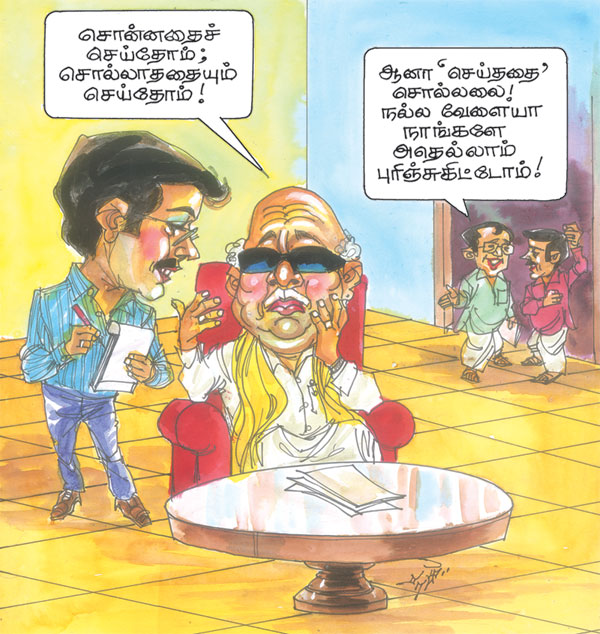
After the defeat of DMK and company in May 2011 elections, the Tamil satire journal Thuglak ran a funny cartoon, where the DMK chief laments "We did what we said, we also did what we did not say (still got defeated)". While the common man chides "Yeah right, but they did not say what they did", refering the 2G spectrum scam.

Translating this humor to Samskritam is interesting, using the "ktat" pratyaya for past-tense. Though it is blasphemous imagining the DMK chief speaking in Sanskritam, we can sense the brevity of the language here. (Paranthesis are author's additions for emphasis)


DMK प्रमुख:  - उक्तम् कृतम् । अनुक्तमपि कृतम् । (हन्त! तथापि वयम् जिता:!)
कश्चन जन:  - परन्तु (यत्) कृतम् (तत्) न उक्तम् खलु ।

Conveying the meaning not in so many words may not be a Bollywood technique, where heroes and moms dole out tiring breathless dialogs, but is pretty common in speech. Writing or reading between the lines, so to speak. That skill comes in handy in the corporate world whether to blame someone or pass the buck.

Sanskritam literature offers a lot of delightful examples in various degrees of "being left unsaid". Anandavardhana, in his masterpiece dhvanyaaloka (11th century CE) classifies it as a "suggestive technique". We shall look at a few instances.

One of the most beautiful is from kumaarasambhava, a shloka of which we saw in an earlier post about the penance of Parvati for Shiva. But if you go back and read it again, what is left unsaid in that shloka is equally fascinating. Follow the way the raindrop falls on Parvati and moves about. The described kinetics of the raindrop is possible only if Parvati was sitting in a perfect yogic posture. Kalidasa indeed suggests how Parvati is seated just by describing the movement of a raindrop. Perhaps this was the shloka that inspired Jakanachari shilpi to come up with the masterpiece Darpana-Sundari in Belur.

त्रिविक्रम पण्डिताचार्य, whom we referred in an earlier post composed a stuti called hari-vaayu-stuti, where he praises hanumaan (vayu), bhIma, madhvaacaarya and viShNu. It is set in a fascinating meter called srag-dharaa ("worn as a garland") with 21 syllables per paada. That makes 21x4 = 84 syllables per shloka, with a total of 41 shlokas! (The same in anuShTubh meter would have had 84*41/32 = 108 shlokas!). Sri Madhvaacaarya said that a stuti must begin with a praise to hari and instantly composed two shloka-s (some say it is just one) praising just the nails of narasimha (narasimha-nakha-stuti). These shlokas are recited at the beginning and end of hari-vaayu-stuti. But the beauty of these shloka-s also lies in what he did not directly say. The narasimha-nakha-stuti is in two different meters - a rare instance in Sanskritam literature. The first two paada-s are in a meter called "shaardUla vikrIDitam" (= play of a Lion) and the second two paada-s are in srag-dharaa, the same as that of hari-vaayu-stuti. So he also conveys the story of narasimha avatara - play of a Lion and wearing of a garland (hiraNyakashipu) - just by selecting the aptly named Chandas.

In the above instances, its the author who uses indirect suggestive techniques. In hanumannaaTaka we find sItA conveying her thoughts without saying any words. On the way to sItA's svayamvara, her friends enquire that 'if that blue-bodied man' will be her husband. sItA does not say anything, yet conveys the acknowledgement by the mere blushing of cheeks and movement of her eyelids. A superb shloka in maalinii Chandas:


पथि पथिकवधूभि: सादरम् पृच्छ्यमाना कुवलयदलनील: कोऽयमार्ये तवेति ।
स्मितविकसितगण्डं व्रीडविभ्रान्तनेत्रम् मुखमवनमयन्ती स्पष्टमाचष्ट सीता ॥

पदच्छेद:

पथि पथिक-वधूभि: सादरम् पृच्छ्यमाना कुवलय-दल-नील: क: अयम् आर्ये तव इति ।
स्मित-विकसित-गण्डं व्रीड-विभ्रान्त-नेत्रम् मुखम्-अवनमयन्ती स्पष्टम्-आचष्ट सीता ॥

आर्ये! क: अयम् कुवलय-दल-नील: तव? इति पथिक-वधूभि: पथि सादरम् पृच्छ्यमाना सीता, स्मित-विकसित-गण्डं व्रीड-विभ्रान्त-नेत्रम् मुखम् अवनमयन्ती, स्पष्टम् आचष्ट ।


Beginner Sanskritam students can recognize the question form "kim etat bhavata:? - Is this yours?". Obviously there are many more such fascinating examples in the gamut of Sanskritam literature.